Navel Piercing Jewelry
This section covers the choice of jewelry that is best for Navel Piercings. Which, due to its placement, can be somewhat limited in the selection of style, gauge, and size of jewelry.
Piercing Placements:
There are two different styles of navel piercings depending on your anatomy:
- The more traditional navel placements are where the piercing is more outside of the navel. This works best on navels that are not deep, and the client's body is less curvy.
- Floating navels are done deeper into the navel. These are best for those who have a deeper navel, are more hourglass-shaped, and/or whose navel collapses when they sit down.
The fact is that when we pierced navels in the 1990s with rings, the piercing was angled more like that of a floating navel. With the increased availability of curved barbells and the popularity of those with gems on the top and bottom, the piercing was moved more outside of the navel. This trend also reduced the number of people who had the correct anatomy for the piercing unless it was pierced with circular jewelry.
Jewelry Style:
- Threaded Straight or Curved Jewelry, such as Curved Barbells or Gem Navel Bars:
- The Advantages:
- A lower profile may reduce the risk of abuse from contact with clothing, bedding, etc., and be less noticeable.
- Since the jewelry is threaded, it can be easily removed if needed.
- The Disadvantages:
- Jewelry should be longer than necessary to accommodate swelling, discharge, and cleaning. This often means more weight, increased likelihood of abuse from contact or catching on clothing, bedding, etc, or being pulled or twisted.
- If the jewelry is too tight, there is no extra room at all, and it can cause the jewelry to become impacted.
- The tightness of the ends needs to be checked regularly to prevent the jewelry from falling out and the piercing from closing. This increases contact with the piercing and increases the likelihood of cross-contamination.
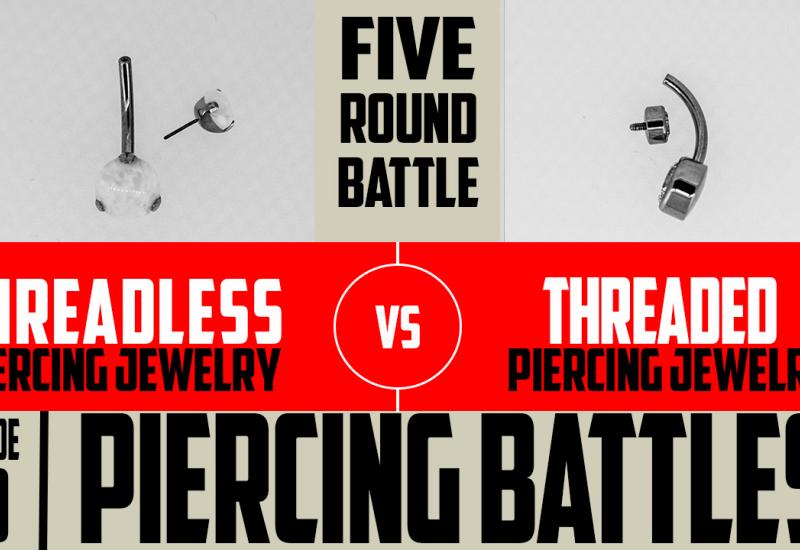
- Threadless or Threaded Floating Navel Curved Barbells
- The Advantages:
- The flat disc on the bottom of the jewelry doesn't take up as much space and can be more comfortable.
- A lower profile may reduce the risk of abuse from contact with clothing, bedding, etc., and be less noticeable.
- Since the jewelry is Thredless or threaded, it can be easily removed if needed.
- Most studios stock a massive variety of Threadless ends. Making it much easier to create a personal custom style for you.
- With only the top visible, it will appear more like a single-point piercing or as if it is just floating above your navel.
- The Advantages:
- The Disadvantages:
- Jewelry should be longer than necessary to accommodate swelling, discharge, and cleaning. This often means more weight, increased likelihood of abuse from contact or catching on clothing, bedding, etc, or being pulled or twisted.
- If the jewelry is too tight, there is no extra room at all, and it can cause the jewelry to become impacted.
- The tightness of the ends needs to be checked regularly to prevent the jewelry from falling out and the piercing from closing. This increases contact with the piercing and increases the likelihood of cross-contamination.
- With threadless jewelry, extra caution will be needed to make sure not to snag the top.
- Jewelry that should be avoided during Healing or for long periods after healing:
- Novelty Curved Barbells with large ends, charms, and shaped ends and/or dangles:
- Considerably shaped charms that sit inside the navel often have sharp edges and points that can cause problems
- Shaped objects are usually made of sub-standard metals like copper, sterling silver, brass, low-grade steel, Pewter, and even chrome-plated plastics. These increase the risk of allergic reactions to the metals and fungal infections when the jewelry becomes tarnished.
- Dangles and other items hanging off the jewelry increase stress and abuse to the piercing, which will lead to prolonged healing, tearing, scarring, rejection, and migration.
- Ear Piercing Studs and other traditional jewelry:
- The jewelry is often too short to accommodate the thickness of the piercing area, which prevents swelling and can cause the jewelry to become impacted in the piercing. Additionally, if the jewelry is too tight, it can block both the discharge and the flow of oxygen, which can prolong healing time and/or increase the risk of infection or other complications.
- The backs or locks are loose and can be tightened with normal wear.
- Often, the jewelry material is not body-friendly. Even those marketed to individuals with metal sensitivity are only plated.
- In most cases can not be sterilized correctly.
- Novelty Curved Barbells with large ends, charms, and shaped ends and/or dangles:
Size of the Jewelry and Weight:
- Gauge:
As a refresher, gauge refers to the thickness of the wire used to make the jewelry. Body piercing jewelry typically ranges from 18-gauge to 0000-gauge. The smaller the number, the thicker the jewelry will be. As I'm sure you know, the thicker the jewelry is, the more weight it carries and thus the more stress it puts on the piercing during the healing period. Additionally, the thicker the jewelry, the more tissue that needs to be produced, resulting in a more extended healing period. Although in most cases, an 18-gauge piercing will heal in about the same time as a 12-gauge piercing.
When choosing the gauge of the jewelry, the jewelry needs to be thick enough to reduce rejection or migration and have resistance to tearing, but light enough that it will not cause added stress during healing. Due to the location of the piercing, there are additional concerns of rejection or migration. For this reason, larger gauge jewelry is usually the better choice. Not only for healing, but after healing, thicker jewelry is going to feel better if pressure is put on it, but it is a great deal less likely to tear. In my experience, 14g or larger feels much more comfortable than thinner jewelry in the long run.
With Navel piercings, the best balance between weight and resistance is 14 gauge. Depending on the shape of the piercee's navel, the piercing can be done with larger gauges.
- Width:
The jewelry needs to be large enough to allow extra room for swelling, discharge, and cleaning. If the piercing is done with a barbell, this usually means that the jewelry must be done with a much longer piece than is needed, thus adding additional weight and risks.
Even in a healed piercing, you should not put jewelry in that has a tighter circle than the original jewelry used for the piercing. In other words, if it were pierced with a 3/8-inch-wide ring, you would not want to put a 1/4-inch ring in because it would create a tighter circle. The reason for this is that it can cause migration, scarring, and tearing of the piercings. If you want something with a lower profile, a curved barbell would be a better choice because they are usually a mild 1/4 turn. Even with a curved barbell, you want it to be slightly longer than the piercing. The jewelry should never be so tight that it changes the shape of the piercing or piercing area.
In conclusion, nothing replaces the first-hand knowledge of a professional piercer when it comes to choosing the correct jewelry. There are vast differences in shape and size, and often, what works for 99.99% of the public is not the best choice for you. The goal of this is to provide you with a working understanding of jewelry selection, so that you can have an informed discussion with your piercer about what will work best. Every piercer understands that one of the motivations of getting the piercing is fashion, but jewelry that will produce the best outcome should always rule out fashion. Think of the jewelry used for the piercing as temporary, or trainer jewelry, that will be replaced with your preferred choice once the piercing is healed.